OPI / Personality Test | ISSB, PMA, AFNS, AMC and LCC
Assalam-o-Alaikum everyone.
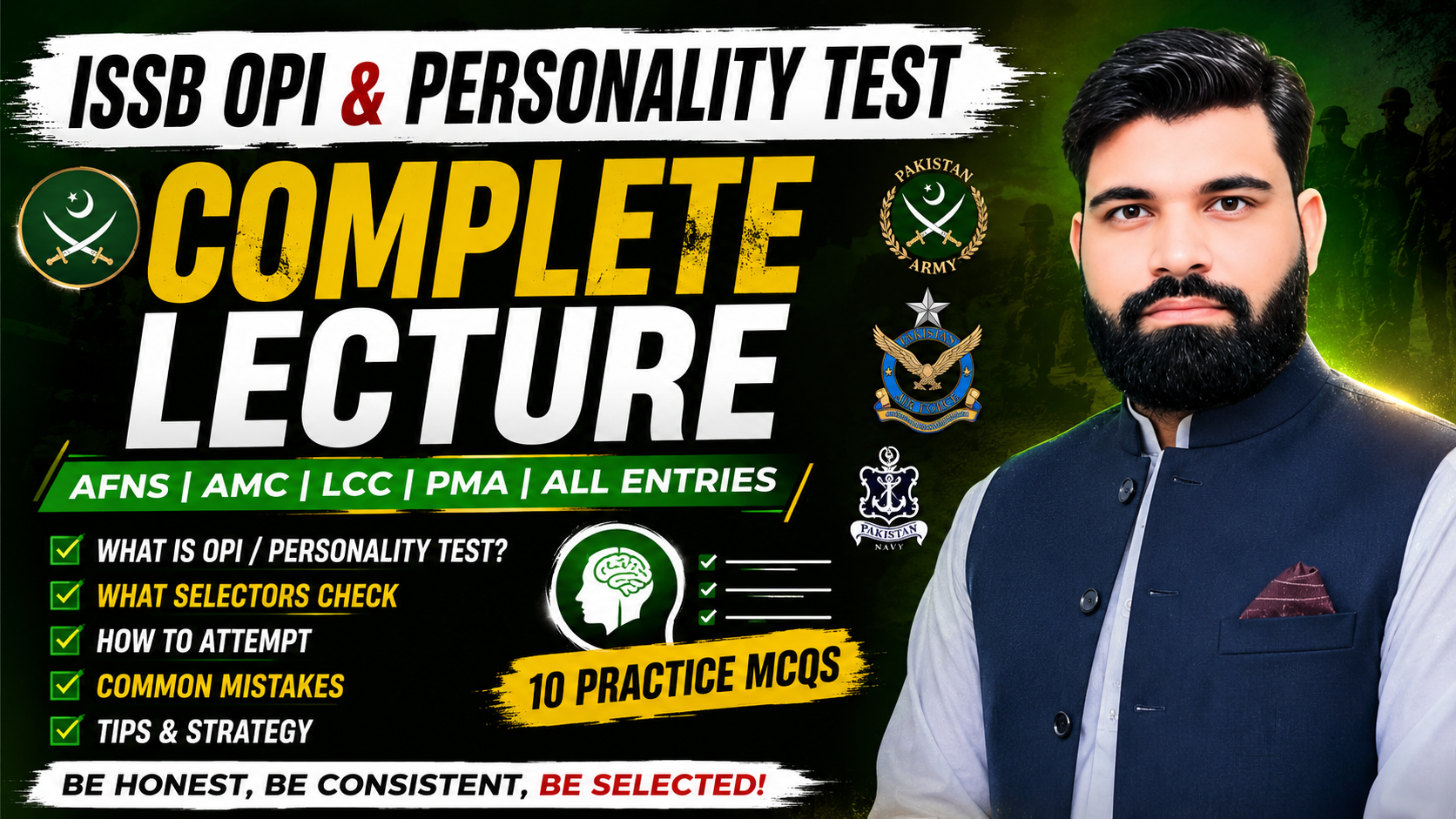
Today’s lecture is about the personality assessment conducted during the selection process for the Pakistan Armed Forces.
At the Inter Services Selection Board, or ISSB, this assessment is commonly referred to as the OPI, meaning Omnibus Personality Inventory. In the initial or relevant selection stages of entries such as AFNS, AMC and LCC, candidates commonly know it as the Personality Test.
Although the names may differ according to the entry and testing stage, the general purpose is similar: to understand the candidate’s personality, emotional stability, social adjustment, sense of responsibility and suitability for military life.
1. What Is the OPI or Personality Test?
The OPI or Personality Test is a psychological assessment consisting of statements about a candidate’s thoughts, emotions, habits and behaviour.
Candidates are normally required to indicate how strongly they agree or disagree with each statement.
Typical response options may include:
- Strongly disagree
- Disagree
- Slightly disagree
- Neutral or uncertain
- Slightly agree
- Agree
- Strongly agree
Candidates must carefully follow the instructions displayed on the computer screen or provided by the testing staff, because the response format can vary.
The test is not based on academic knowledge. It does not test mathematics, English, biology, current affairs or general knowledge. It examines how candidates normally think, feel and behave.
2. Difference Between OPI and Personality Test
The term OPI is generally associated with the personality assessment conducted during the ISSB process.
The term Personality Test is commonly used by candidates appearing for entries such as:
- Armed Forces Nursing Service, or AFNS
- Army Medical College, or AMC
- Lady Cadet Course, or LCC
- Other relevant armed-forces selection categories
The names may be different, but both assessments examine personality-related characteristics.
The test should therefore not be treated as a conventional examination with one memorized answer key. Its purpose is to develop an overall picture of the candidate.
3. Purpose of the Test
The personality assessment helps the selectors understand whether a candidate possesses the qualities required for military training and service.
It may examine the following areas:
Emotional stability
The test assesses how candidates react to pressure, criticism, failure, conflict and difficult situations.
A suitable candidate should normally remain calm and controlled. This does not mean that the candidate never experiences fear, sadness or anger. It means that emotions do not completely control the candidate’s behaviour.
Self-confidence
Candidates should have confidence in their abilities while remaining realistic and willing to learn.
Confidence is different from arrogance. A confident person can express an opinion, accept responsibility and admit a mistake. An arrogant person believes that others are always inferior or wrong.
Sense of responsibility
Military officers and personnel must be dependable. The assessment may examine whether candidates complete assigned tasks, fulfil promises and accept responsibility for their decisions.
Social adjustment
The Armed Forces require teamwork. Candidates should be able to communicate, cooperate and work with people from different backgrounds.
Leadership potential
Leadership includes taking initiative, guiding others, making timely decisions and accepting responsibility for the group.
Leadership does not mean controlling or dominating everyone.
Honesty and integrity
Candidates are expected to be truthful, trustworthy and morally responsible. Trying to present an unrealistically perfect personality can create contradictions in the test.
Courage and resilience
The assessment may examine whether candidates recover after disappointment and continue working despite difficulties.
Resilience means learning from failure instead of losing hope immediately.
Discipline
Candidates should respect rules, time and lawful authority. They should also demonstrate self-control and an organized approach to their responsibilities.
4. Nature of the Statements
The test may contain positive, negative and repeated statements.
Positive statements
Examples include:
- I remain calm during difficult situations.
- I enjoy helping other people.
- I complete my work on time.
- I can take responsibility for my decisions.
Negative statements
Examples include:
- I become angry over minor issues.
- I often leave difficult tasks unfinished.
- I avoid responsibility whenever possible.
- I lose hope quickly after failure.
Candidates must read negative statements carefully. Agreeing with a negative statement has a different meaning from agreeing with a positive statement.
Repeated or similar statements
The same personality characteristic may be examined through different statements.
For example:
- I enjoy working in a team.
- I prefer avoiding group activities.
- I can easily cooperate with other people.
These statements may appear in different parts of the test. Their purpose may be to examine the consistency of the candidate’s responses.
5. How to Attempt the Test
Be honest
The most important rule is to answer according to your actual personality.
Do not continuously ask yourself:
“What would an ideal officer select?”
Instead, ask:
“What is normally true about me?”
Artificial answers may conflict with one another and may also conflict with your interview, psychological tests or actual behaviour.
Read every statement carefully
Pay particular attention to words such as:
- Always
- Usually
- Often
- Sometimes
- Rarely
- Never
- Not
For example:
“I am easily discouraged.”
and
“I am not easily discouraged.”
have opposite meanings.
Avoid pretending to be perfect
No candidate is brave, calm, confident and successful at every moment.
Statements such as the following may require realistic responses:
- I have sometimes made mistakes.
- I occasionally feel nervous in unfamiliar situations.
- I have experienced disappointment after failure.
Admitting normal human emotions does not automatically make someone unsuitable. What matters is the overall personality pattern.
Avoid using the neutral option unnecessarily
Select the neutral or uncertain option only when you genuinely cannot decide.
Repeatedly choosing the middle option may indicate indecisiveness or an unwillingness to express a clear position.
Maintain a reasonable speed
Do not spend too much time trying to discover a hidden meaning behind every sentence.
Read the statement, understand it and select the response that best represents your usual behaviour.
Do not memorize answer keys
Personality tests do not have a universal answer key suitable for every candidate.
A response that is true for one individual may be false for another. Memorized responses may produce inconsistencies.
6. Characteristics of a Balanced Military Candidate
A suitable candidate is not expected to be perfect. The candidate should demonstrate a balanced and mature personality.
A balanced candidate:
- Is confident but not arrogant
- Is disciplined but not blindly rigid
- Can lead but can also follow lawful instructions
- Is courageous but does not take foolish risks
- Is sociable but can also work independently
- Is emotionally controlled but not emotionless
- Accepts criticism without becoming defensive
- Recognizes weaknesses and works to overcome them
- Makes decisions while considering relevant facts
- Supports teammates and accepts responsibility
The Armed Forces generally require individuals who can function effectively under pressure while maintaining discipline, cooperation and integrity.
7. Common Mistakes
Choosing extreme responses for every statement
Selecting “strongly agree” for all positive statements and “strongly disagree” for all negative statements may appear artificial.
Use extreme responses only when the statement strongly represents your actual personality.
Trying to look unrealistically brave
A candidate should not claim to have never experienced fear, anxiety or doubt.
Real courage means controlling fear and performing one’s duty despite it.
Contradicting previous answers
A candidate may first agree that they enjoy teamwork and later agree that they dislike working with people.
This can happen when responses are being manufactured instead of given naturally.
Ignoring negative wording
Candidates sometimes read quickly and overlook the word “not.”
For example:
“I do not lose hope easily.”
Agreeing with this statement indicates resilience.
Selecting socially desirable answers only
Candidates sometimes choose what sounds morally or socially impressive rather than what is genuinely true.
The purpose of the test is not to reward impressive vocabulary or artificial perfection.
Attempting the test carelessly
Although candidates should respond naturally, they must not click options randomly. Careless responses can create an inaccurate personality profile.
8. How to Prepare
Preparation should focus on personality development rather than memorization.
Candidates can prepare by:
- Maintaining a disciplined daily routine
- Completing tasks on time
- Participating in sports and group activities
- Improving communication skills
- Accepting responsibilities at home, college or work
- Learning to control anger and frustration
- Developing confidence through public speaking
- Practising decision-making in everyday situations
- Learning from failure
- Improving general awareness
- Reflecting honestly on personal strengths and weaknesses
Candidates should ask themselves:
- How do I react when I fail?
- Can I accept criticism?
- Do I complete difficult tasks?
- Can people depend on me?
- Do I cooperate with others?
- Can I control my anger?
- Do I admit my mistakes?
- Can I make decisions under pressure?
- Do I help others without expecting a reward?
- What weaknesses am I currently trying to overcome?
Honest self-analysis helps candidates respond naturally and consistently.
Practice Personality-Test Questions
Instructions
For each statement, choose the option that most closely represents your usual behaviour.
A. Strongly disagree
B. Disagree
C. Slightly disagree
D. Neutral or uncertain
E. Slightly agree
F. Agree
G. Strongly agree
Remember that these are personality-practice questions. There is no universal answer key that every candidate should copy.
Question 1
I remain calm when other people criticize my work.
A. Strongly disagree
B. Disagree
C. Slightly disagree
D. Neutral or uncertain
E. Slightly agree
F. Agree
G. Strongly agree
Characteristic being assessed: Emotional control and acceptance of feedback.
Question 2
I often leave a difficult task unfinished.
A. Strongly disagree
B. Disagree
C. Slightly disagree
D. Neutral or uncertain
E. Slightly agree
F. Agree
G. Strongly agree
Characteristic being assessed: Persistence, determination and responsibility.
Question 3
I can admit my mistake without blaming another person.
A. Strongly disagree
B. Disagree
C. Slightly disagree
D. Neutral or uncertain
E. Slightly agree
F. Agree
G. Strongly agree
Characteristic being assessed: Honesty, maturity and accountability.
Question 4
I avoid speaking when a group requires a decision.
A. Strongly disagree
B. Disagree
C. Slightly disagree
D. Neutral or uncertain
E. Slightly agree
F. Agree
G. Strongly agree
Characteristic being assessed: Confidence, initiative and decision-making.
Question 5
I cooperate with people even when their opinions are different from mine.
A. Strongly disagree
B. Disagree
C. Slightly disagree
D. Neutral or uncertain
E. Slightly agree
F. Agree
G. Strongly agree
Characteristic being assessed: Teamwork, tolerance and social adjustment.
Question 6
Minor problems make me extremely angry.
A. Strongly disagree
B. Disagree
C. Slightly disagree
D. Neutral or uncertain
E. Slightly agree
F. Agree
G. Strongly agree
Characteristic being assessed: Anger management and emotional stability.
Question 7
I am willing to take responsibility when a group task fails.
A. Strongly disagree
B. Disagree
C. Slightly disagree
D. Neutral or uncertain
E. Slightly agree
F. Agree
G. Strongly agree
Characteristic being assessed: Leadership, responsibility and moral courage.
Question 8
After failure, I identify my mistakes and try again.
A. Strongly disagree
B. Disagree
C. Slightly disagree
D. Neutral or uncertain
E. Slightly agree
F. Agree
G. Strongly agree
Characteristic being assessed: Resilience, optimism and self-improvement.
Question 9
I change my opinion whenever people disagree with me.
A. Strongly disagree
B. Disagree
C. Slightly disagree
D. Neutral or uncertain
E. Slightly agree
F. Agree
G. Strongly agree
Characteristic being assessed: Confidence, independent thinking and resistance to social pressure.
Question 10
I follow rules only when someone is watching me.
A. Strongly disagree
B. Disagree
C. Slightly disagree
D. Neutral or uncertain
E. Slightly agree
F. Agree
G. Strongly agree
Characteristic being assessed: Integrity, discipline and internal sense of responsibility.
Important Note About the Practice Questions
These questions should be used to understand the format and improve self-awareness.
Candidates should not memorize particular options. For example, although emotional stability, responsibility, teamwork and honesty are desirable qualities, repeatedly selecting extreme options without considering one’s real personality may create an unrealistic response pattern.
The correct approach is to:
- Read the complete statement.
- Notice whether it is positive or negative.
- Think about your usual behaviour.
- Select the most honest response.
- Avoid overthinking or attempting to manipulate the assessment.
Conclusion
To conclude, the OPI at ISSB and the Personality Test for AFNS, AMC and LCC candidates are psychological assessments intended to understand a candidate’s overall personality.
They may examine emotional stability, confidence, honesty, discipline, leadership potential, teamwork, resilience and sense of responsibility.
The best way to perform well is not to memorize answers. Candidates should understand themselves, improve their genuine weaknesses and answer every statement honestly and consistently.
The Armed Forces do not require an individual who merely claims to be perfect. They require a balanced, dependable and disciplined person who can learn, cooperate, accept responsibility and perform effectively under pressure.
Thank you. Pakistan Zindabad.